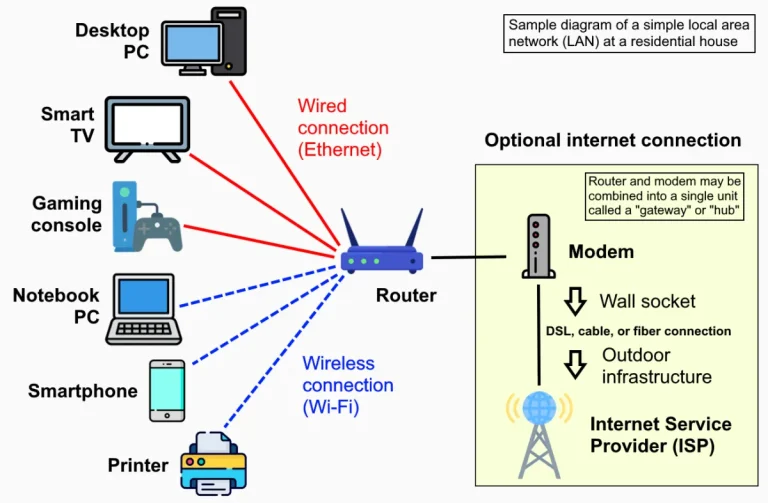


Many modern routers broadcast two networks simultaneously: 2.4 GHz and 5 GHz. Both have their own advantages.
2.4 GHz Wi-Fi
- It has a longer range and is better at penetrating walls.
- Slower speeds compared to 5 GHz.
- It’s more congested, as it’s used by many routers, Bluetooth devices, and even microwaves.
- Supported by almost all devices, including older smartphones and IoT devices.
5 GHz Wi-Fi
- Faster, ideal for streaming, video conferences, and large downloads.
- Shorter range; the signal weakens more quickly when passing through walls.
- Less interference because there are more and wider channels.
- Not all older devices support it.
Which one should you use?
| Situation | Option |
|---|---|
| One room with the router; need fast speeds | 5 GHz |
| Distant room or different floor | 2.4 GHz |
| Older devices, printers, CCTV | 2.4 GHz |
| Dense environment with many neighboring Wi-Fi networks | 5 GHz |
For hotspots and neighborhood networks
In large outdoor areas, 2.4 GHz is often used for range, while 5 GHz is used for point-to-point connections that require high speeds. Also be aware of the frequency regulations in effect in Indonesia when using outdoor devices.
Tips
Give each network a different name, for example RumahKu and RumahKu-5G, so you can choose between them. If your laptop doesn’t support 5 GHz yet, a dual-band USB Wi-Fi adapter could be a good option.

Written by
Tim Digitize Store
The Digitize Store team: technicians and digital product makers helping you choose and use technology well.